

Implementing the active recall study method enables students to overcome the illusion of competence caused by passive re-reading and highlighting. Indeed, in his seminal work How We Learn, science journalist Benedict Carey demonstrates that the human brain functions not as a passive storage vessel, but as a muscle strengthened exclusively through active retrieval efforts. Consequently, forcing the mind to extract information without looking at source materials strengthens neural pathways. As a result, learners build durable long-term memory connections.
Active Recall Study Method: Breaking Passive Habits
Traditional review habits like re-reading notes and marking passages with highlighters create a false sense of mastery. Crystalline familiarity often leads students to believe they know the material, yet their minds go blank during actual exams.
Conversely, active retrieval flips the learning process entirely. Instead of repeatedly pushing data into the brain, this strategy forces the mind to pull knowledge out from deep memory storage.
| Learning Approach | Information Dynamics | Biological Outcome |
| Passive Review | Unidirectional input | Temporary visual familiarity |
| Active Recall | Conscious memory retrieval | Structural neural consolidation |
Science of the Active Recall Study Method
Carey highlights several core biological mechanisms that make retrieval practice remarkably effective.
Desirable Difficulty: Active Recall Study Method
First, the greater the cognitive effort required to retrieve a memory, the stronger the underlying neural connection becomes. Therefore, the uncomfortable mental exertion of recalling facts against a blank page provides the exact signal required for deep learning.
Error Correction as a Neurobiological Catalyst
Next, failing to retrieve a specific fact during self-testing is not wasted time. In fact, making errors opens a prime biological attention window. When a student verifies the correct answer immediately after an incorrect attempt, the brain rewires the circuit with maximum priority.
The Pre-Testing Effect
Additionally, testing oneself on unfamiliar material before studying yields substantial benefits. Attempting to answer questions from an unread chapter primes the mind, creating an active search state that absorbs new information far more efficiently later.
How Leading U.S. Educational Institutions Implement Active Recall
Top-tier American high schools, elite preparatory academies, and competitive universities actively integrate cognitive retrieval into their official curricula.
- Elite Independent Academies: Prestigious preparatory institutions like Phillips Exeter Academy leverage Harkness discussion tables. In these seminar-style classrooms, students must constantly retrieve, articulate, and defend concepts without reading directly from textbooks.
- Specialized Public High Schools: Competitive STEM centers—such as Thomas Jefferson High School for Science and Technology—structure coursework around low-stakes formative quizzes and daily pre-tests to prime students before lectures.
- Higher Education Medical & Law Programs: Leading medical schools (such as Harvard Medical School and Johns Hopkins) structure learning modules using flashcard algorithms (Anki) and case-based problem solving (PBL). These systems mandate continuous active retrieval to master complex medical diagnoses.
For families navigating academic placement across different tiers, understanding grade expectations is explained in Elementary, Middle, and High School: Understanding U.S. Grade Level Structures. Furthermore, evaluating school academic rigor alongside student outcomes becomes clearer when consulting How to Compare Schools Using Enrollment and Student-Teacher Ratio Data.
Further empirical research on cognitive retrieval and memory consolidation is indexed by the National Library of Medicine.
Actionable Implementation Strategies for Parents and Students
Parents can easily help their children transition from passive reading to active retrieval habits at home through structured, low-stress routines.
- Replace Highlighters with the Blurting Method: Instruct your child to read a section once, close the textbook, and write down every concept they remember on a blank sheet of paper. Afterward, compare their sheet against the book to identify gaps immediately.
- Implement Cornell Note-Taking: Encourage students to write questions in the left margin of their class notes during school. When studying at home, they cover the right side (answers) and use the questions as a self-quiz.
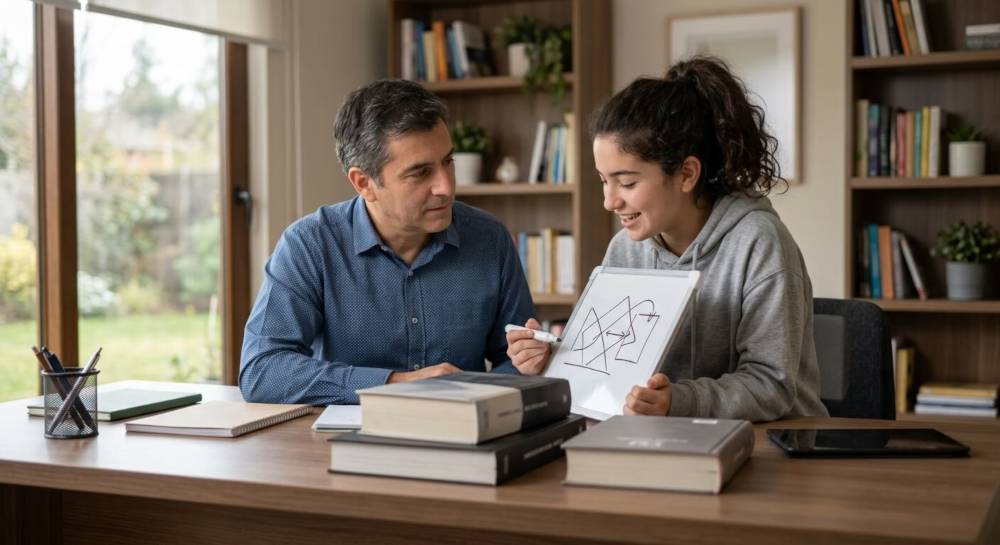
- The Teaching Technique (Feynman Method): Ask your child to explain a complex history or science topic to you in simple terms without checking their notes. If they stumble, that indicates the exact area requiring targeted review.
- Digital Flashcard Systems: Encourage high school students to use spaced-repetition software like Anki or Quizlet. These tools automate review schedules based on how difficult a concept was to retrieve.
Ultimately, integrating active retrieval requires converting standard class notes into targeted practice questions. Therefore, self-evaluate regularly before re-reading materials to maximize retention across all academic subjects.
[…] Higher Education Methodologies: University learning centers frequently combine cognitive teaching strategies with active retrieval methods. In fact, combining these approaches reinforces long-term memory retention significantly, as highlighted in How Does the Active Recall Study Method Enhance Memory Retention?. […]